

When looking for a CNC turning machine for sale, you might think that it is a straightforward process, especially if you do not know that turning and milling are two entirely different techniques of machining metal. You get all the benefits when making the right choice, including speed, productivity, efficiency, and ease of use, but problems start when the wrong machine is chosen.
This is why so many people find themselves asking whether it would be better to buy a CNC turning machine for sale or a milling machine instead. It might be tough since both machines have an excellent level of precision, are widely used in modern industry, and are applied to manufacturing various parts and components. However, these machines serve different purposes.
In this guide, we will tell you everything about CNC turning and milling machines and make sure that you make the right decision when choosing a CNC turning machine for sale.
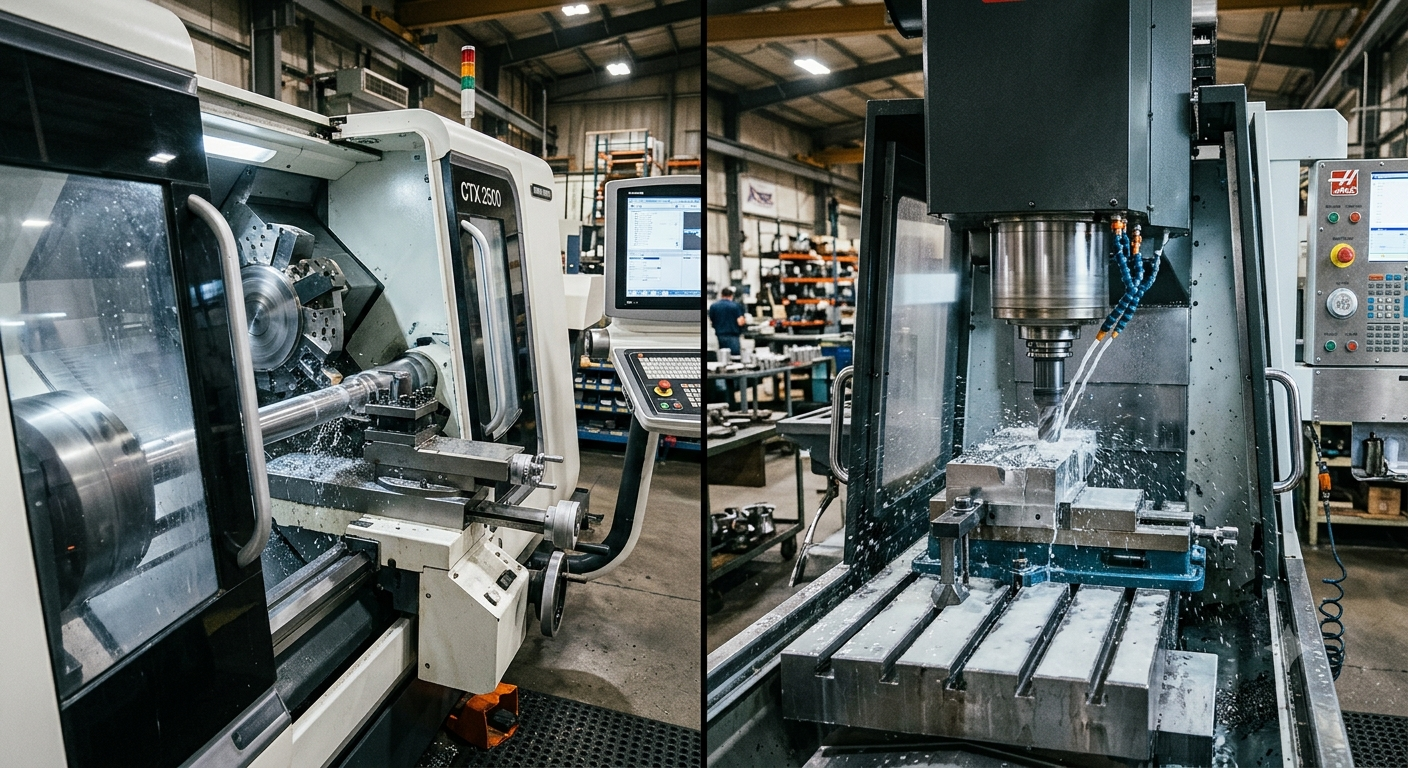
In this case, a CNC turning machine rotates the workpiece. A static cutting tool then shapes the part by removing material from it. That’s why it is also referred to as a CNC lathe machine. More information can be found on Wikipedia.
Turning is recommended for cylindrical parts like
In case your parts have axial symmetry, a CNC turning machine is usually the most effective choice for you.
Milling is the other way round. As the workpiece remains stationary on the stationary table, the cutting tool moves while getting to the workpiece from various angles. As the cutting tool is moved along 3, 4, and even 5 axes, milling makes it possible to produce flat surfaces, slots, pockets, holes, and 3D objects. Find out more about milling in machining.
Examples of milled parts include
| Parameter | CNC Lathe Machine | CNC Milling Machine |
| Part to be processed | Rotates | Remains stationary |
| Cutting tool | Stationary and single-point | Rotates and multi-points |
| Suited for processing | Cylindrical shapes | Complex shapes, flat or three-dimensional shapes |
| Processing speed for cylindrical shapes | Very high | Slower |
| Design freedom | Low | High |
| Complexity of setup process | Low | High |
Turning:
Milling:
Many modern manufacturing plants use both types of equipment. The current generation of CNC lathes available for purchase in the market today even feature live tooling capability and can perform some milling and drilling tasks.
Ask yourself the following questions prior to looking at a CNC turning machine for sale:
If more than 70% of your parts are cylindrical, investing in a CNC turning machine for sale will be much more profitable than milling.
Not every company has to own a machine. If the orders are infrequent and in small quantity, outsourcing is more economical than owning a machine. You can use on-demand machining services like Xometry and Protolabs that offer excellent services. However, having your own machine offers you control over the quality, lead time, and cost.
Prior to purchasing, make sure you have checked the following:
When it comes to comparing choices, it helps to work with an experienced provider. Yiruixing Technology provides different types of precision machines and automation solutions tailored for rigorous industrial needs. Regardless of whether it’s a CNC turning machine for sale for mass shaft manufacturing or a CNC lathe machine for sale with a variety of additional functions, the specialists will help you choose the suitable configuration.
Those who want to learn more about the automated manufacturing process will find the numerical control information useful.
Ready to Boost Your Manufacturing Capacity?
No need to make any assumptions. Visit Yiruixing Technology and discover the machines on offer as well as discuss the CNC turning machine for sale you may need.
1. Difference between CNC turning and CNC milling
In CNC turning, the part or workpiece is rotating against the fixed tool. On the other hand, in CNC milling, the rotating cutting tool works against the stationary workpiece.
2. Are a CNC lathe and a CNC turning machine the same?
Yes. Both CNC lathes and CNC turning machines are the same thing. That is why people tend to look for CNC lathe machines for sale and CNC turning machines for sale.
3. Which machine is good for small enterprises?
It all depends on your parts. A CNC turning machine turns out to be economical if you manufacture cylindrical parts.
4. Is it possible for a machine to be used for turning as well as for milling?
Yes, there are turning milling centers and lathes with live tooling that are capable of doing both.
5. What should be taken into consideration before buying a CNC turning machine?
Considerations should include power of the spindle, chuck capacity, controller, durability, warranty, and after-sales service.

