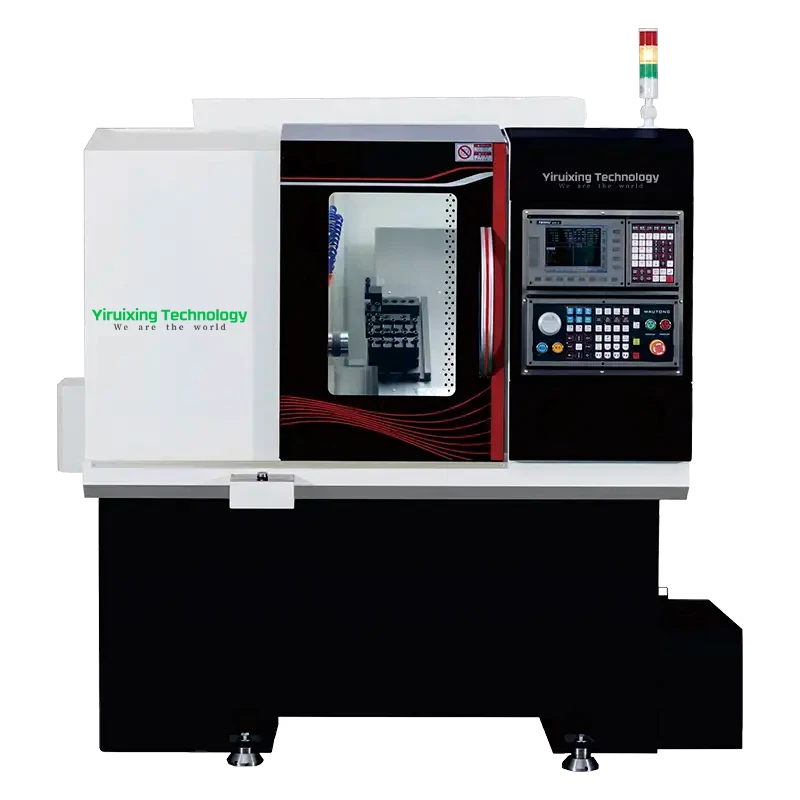
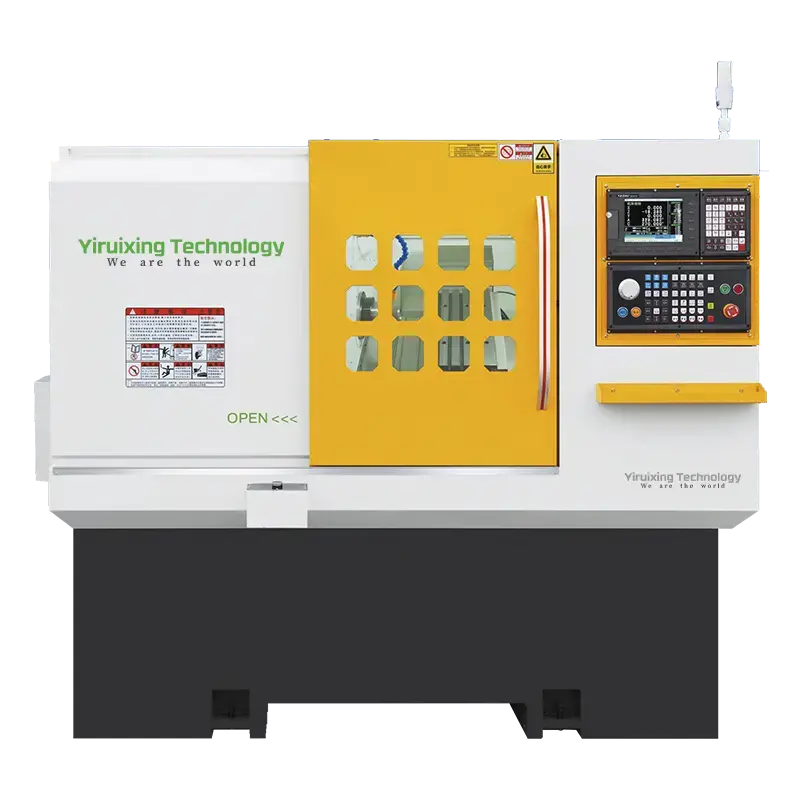
CNC lathe machines form an important category of machine tools required for accurate and repeated manufacture of complex rotating parts in various manufacturing industries. The CNC lathe machine automates machining movements using computerized numerical control, and the workpiece rotates against the cutting tools to achieve the required geometry.
ISO 23125 defines a turning machine as “a machine tool in which the main movement is the rotation of the workpiece against the cutting tools.” The standard also specifies that CNC Turning machines and CNC Turning Centres constitute industrial machine tool categories.
The worldwide CNC machine tool industry has been growing steadily due to the development of automation and precision engineering in machine tools using digital controls. According to Grand View Research, the global CNC machine tools market size is estimated at USD 100.52 billion in 2025, with a forecast CAGR of 5.9% from 2025 to 2033, to reach approximately USD 159.14 billion by 2033.
The forecasted value of the market for the CNC lathe and turning centres segment is USD 3.70 billion in 2025, and a CAGR of 6.8% for the forecast period, according to a 2026 market research report.
These numbers illustrate the increasing tendency for the adoption of automation and digitally controlled solutions.
CNC lathes allow manufacturers to perform machining process control, repeatable manufacturing processes, and efficient production of precise cylindrical parts. The process of turning, depending on the configuration of CNC lathe machines, can be divided into such processes as facing, external and internal turning, threading, grooving, boring, drilling, and contouring.
Modern turning centres can unite several machining processes in one setup. According to ISO, a turning centre can feature a number of processes such as threading, boring, milling, grinding, and drilling, depending on its configuration.
This allows for the optimization of setups and a more efficient manufacturing process.
Since computer controls direct the motion of the tools, manufacturers can repeat their programming of machining processes reliably within each production run.
The automation of the process eliminates repetitive human intervention and provides for reliable cycling, which makes CNC lathes appropriate for batch and mass production.
CNC turning systems allow for manufacturing of many types of rotational parts from relatively simple shafts and bushes to more complicated thread-cutting and shaped components.
The CNC turning machines may be equipped with workholding devices, bar feeders, robotic loaders and unloaders, inspection equipment, and other automated production systems. The standard ISO 23125 also covers turning machines incorporated in automatic production lines or turning cells.
CNC lathe machines are employed in the manufacture of automotive, aerospace, defense, medical devices, oil and gas, energy, electronic, hydraulics, engineering, and general machinery components.
Typical components are shafts, pins, bushes, rollers, couplings, flanges, threads, fittings, hydraulic and mechanical components.
Machine selection would be accurate depending on parameters like maximum turning diameter, turning length, spindle speed, spindle power, chuck capacity, axis travel, turret design, tools, material used, tolerance level, and production quantity, among others.
CNC lathe should be selected depending on the manufacturing requirements and not just the specification only. Manufacturers need to look at things like dimensions of components, material used, required tolerance level, production quantity, and cycle time.
The right CNC turning machine can help the manufacturer create a more repeatable, scalable, and automation-ready machining process.
Discover our CNC Lathe Machines by Yiruixing Technology that fit your modern manufacturing requirements.
What is a CNC lathe machine?
A CNC lathe is a controlled turning machine where the workpiece rotates as the tools perform the desired machining operations.
What products can be made using a CNC lathe?
The CNC lathe is most often used for making rotary parts like shafts, pins, bushes, rollers, couplings, fittings, flanges, and threaded parts.
What are some of the industries that make use of CNC lathes?
The turning process is widely used in the automotive, aerospace, medical, energy, oil & gas, electronics, hydraulics, and engineering industries.
What are some of the key benefits of the CNC turning process?
Some of the key benefits of the CNC turning process include automation, repeatability, machining capabilities, less manual involvement, and the ability to make complex parts.
How do I select a CNC lathe?
Think about the diameter and length of the part, material, tolerance needed, quantity to be produced, spindle requirements, tooling, turret size, and technical assistance needed.