

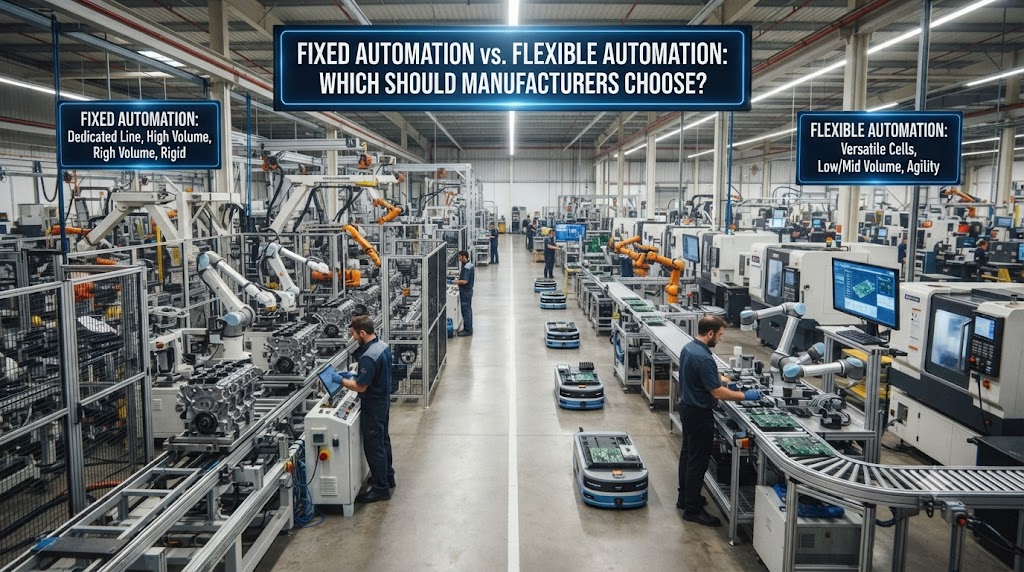
Step into any modern-day manufacturing plant and you’ll see that there are variations in the way their production lines are set up. You’ll find production lines where machines perform one single task repeatedly, often at an ultra-high rate of speed. And you’ll also see other lines where the flow is constantly changing on the fly, with a product mix requiring very little changeover time.
Those variations aren’t just happenstance. They’re a difference between fixed automation and flexible automation – and, if you’re a manufacturer, deciding which type you should choose is a decision that impacts everything from your capital expenditure budget to how nimble you can be in meeting market demand. We’ll take a close look at what each of those options means, where it can be most effective – and how to make the decision for your own facility.
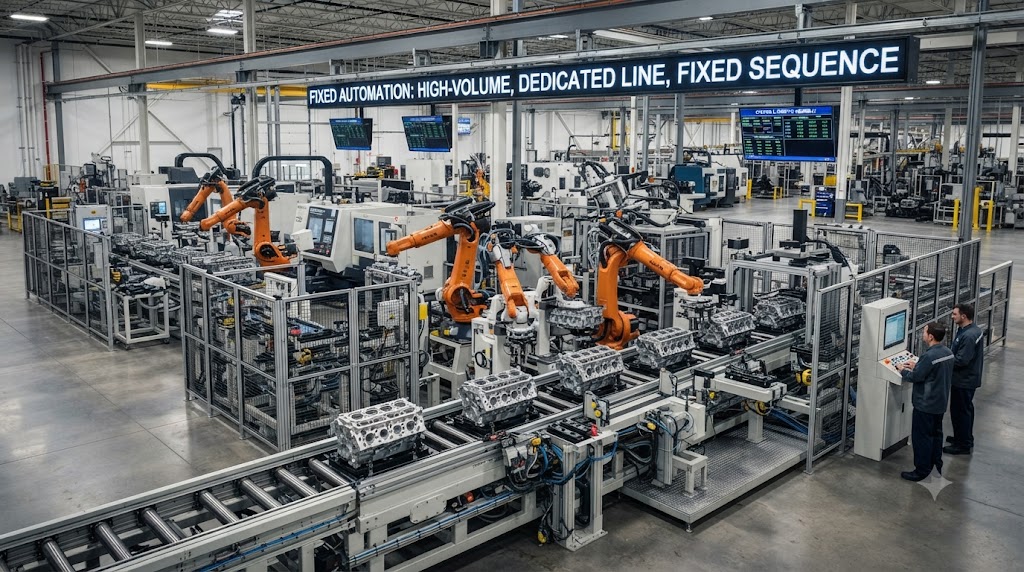
Fixed automation, or hard automation, is used when equipment can be designed to carry out a set sequence of operations without alteration. For example, a production line set up to make one car part or to bottle one type of beverage at a time. The equipment is set up for that specific job so it can produce extremely high rates of output.
The downside of standardization is inflexibility. In general, changing the set of products made by a fixed automation system involves a lot of retooling and downtime – and is expensive. Fixed automation is therefore inappropriate for companies that produce small batches or frequently change the things they make, but well-suited to high-volume, low-variety industries.
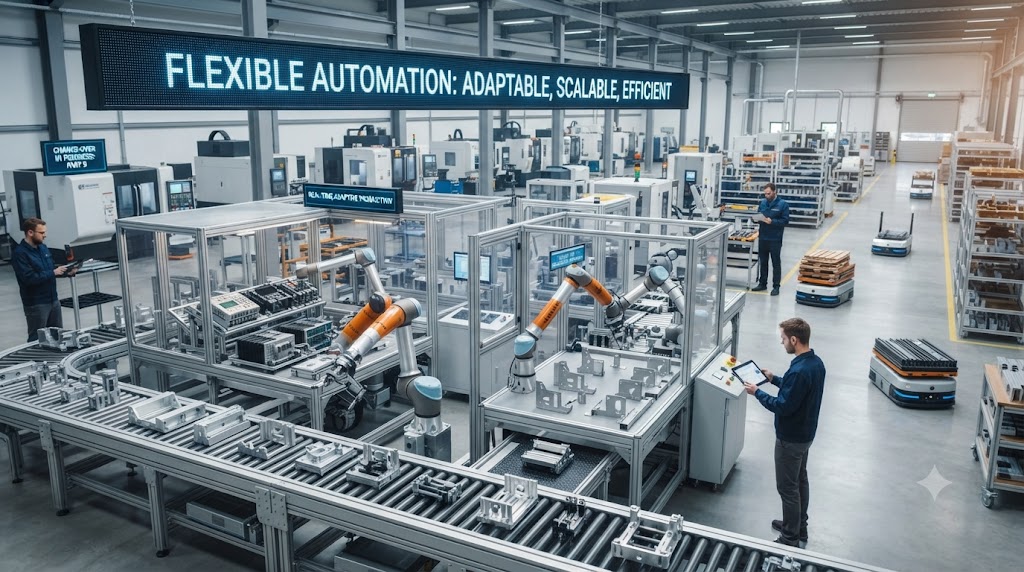
Compared to hard automation, flexible automation is designed to accommodate change. These automated systems- which utilize generally programmable controllers, robotics, and flexible tooling-are reprogrammable and reconfigurable so that they can adapt to new products or new processes without requiring a complete redesign or re-automation. One robotic cell can produce one product early in the day and by the afternoon be producing a different variant of the product with only a new program.
This comes with a cost, however: flexible systems are often significantly more costly to establish, and won’t achieve the same pure throughput of a dedicated fixed line. But for manufacturers with shorter product lifecycles, more frequent customization, or less predictable demand, that flexibility can more than pay for itself many times over.
Knowing these main differences will give you a good idea of what’s right for you:
These two aren’t a matter of which is the “better” technology; rather, it’s about whether your system is a true reflection of your business’ reality. Take a hard look and ask yourself the following questions:
Many manufacturers don’t pick one or the other, as they often mix the two. A hybrid might have dedicated automation on its stable, core product running at high volume, with flexible cells on top of those to quickly build prototypes or slower-moving variants. This enables a plant to gain the cost advantages of dedicated lines without missing out on new opportunities.
There’s no single solution to the fixed-vs.-flexible debate – only the right answer for your product mix, your markets, your growth strategy. Fixed automation is financially sexy if it promises a predictable, scalable return. Flexible automation is more flexible and adjustable. The best manufacturers don’t treat this question as a binary decision – they continually revise their automation mix as markets, products and technology change.
Before you take a leap in automation, consider a partner who can walk you through different types of automation and design a system based on your needs (not just your industry-standard template). At Yiruixing Technology, we work with manufacturers to map out factory requirements and install either fixed, flexible, or a combination of the two automation types that create a more capable, efficient production process for the long term.
I’m just starting to explore automation for my factory — which one should I even be looking into first?
It depends on what you’re making. If you’re making one thing (or a very small product family) in extremely high volumes without frequent product changes, consider fixed automation; it will probably be more economical. But if your product lineup changes frequently or you’re making a few unique products, consider starting with flexible automation despite the higher initial investment.
Is flexible automation always more expensive than fixed automation?
Yes, generally so: With flexible automation you’re investing in machinery, robotics, and modular tooling that will have a higher initial cost to install. But in the long run if you’re changing your product line even a few times, flexible automation is more affordable when you don’t have to retool or replace equipment.
Can I switch from fixed automation to flexible automation later, or do I have to commit from day one?
You don’t have to choose one or the other. Most customers will begin with fixed automation for their main product, then after a few years will look at how to start replacing it with flexible cells. You don’t have to install fixed or flexible automation – you can build up gradually.
What happens if I choose fixed automation and then my product changes?
This is the drawback of fixed automation. If your product is terminated or receives a major revision, the special-purpose machinery would go with it, or you’d have a very costly retooling expense. For that reason, fixed automation works only when you’re pretty sure your product will see few changes for a long time.