

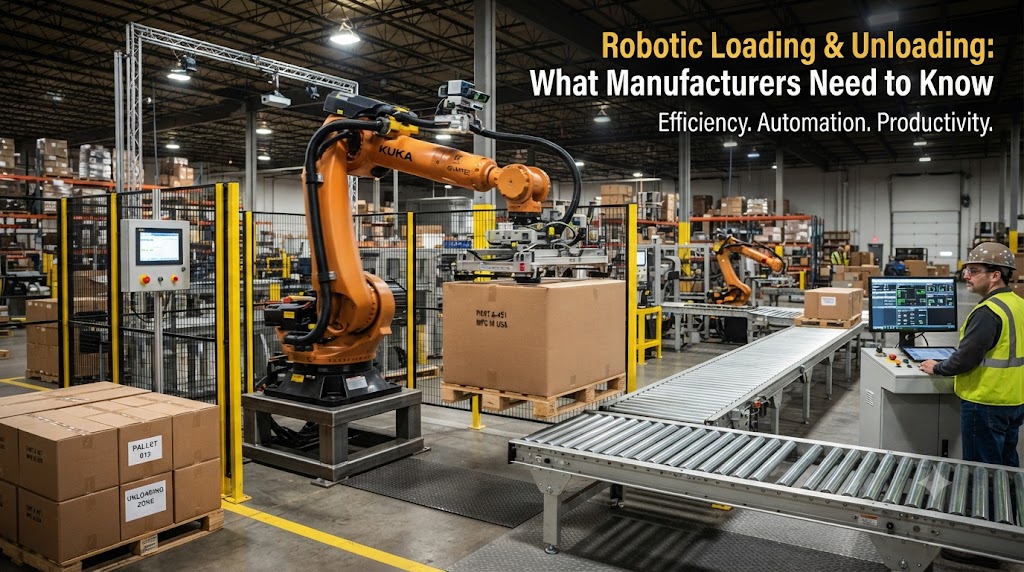
Let’s be real: no one dreams about spending their day throwing boxes out of a sweltering trailer. Still, many factories and warehouses are doing that work by hand, which is evident in the injuries, the sky-high turnover rate, and the trucks that are at the dock, in the way, longer than you’d like. If you’ve ever wondered whether robots could handle that pounding, and if so, how to go about it, you’re not the only one.
The technology has come a long way, and those solutions are no longer just for massive distribution centers with seemingly endless deep pockets. But as you’re shopping around, it helps to understand what these systems are actually capable of-where they will give you a hand, and where they might trip you up. So pour a mug of joe, and let’s go through what manufacturers need to know before going forward.
So here in this blog, we give you proper information about Robotic Loading & Unloading: What Manufacturers Need to Know
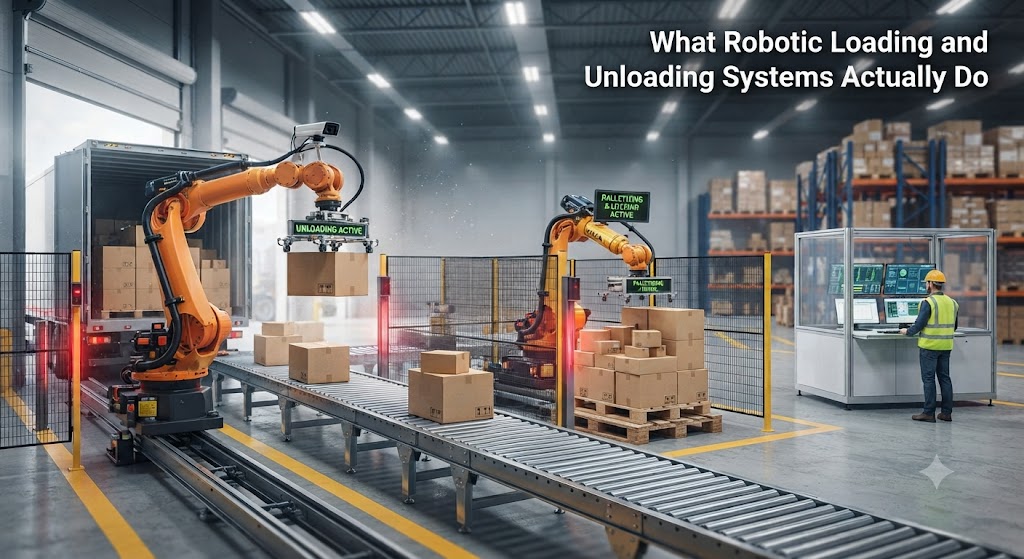
In essence, you can think of these as systems that manually load and unload containers, pallets, and trucks using robotic arms, vision sensors, and integrated software. Cameras or 3D scanners “see” the load of cartons, and the robot determines how to grab and position each one. We’re not trying to replace the entire crew. We want to take the grunt work-moving the heavy stuff and doing the repetitive work- off your people so they can inspect, coordinate, and troubleshoot.
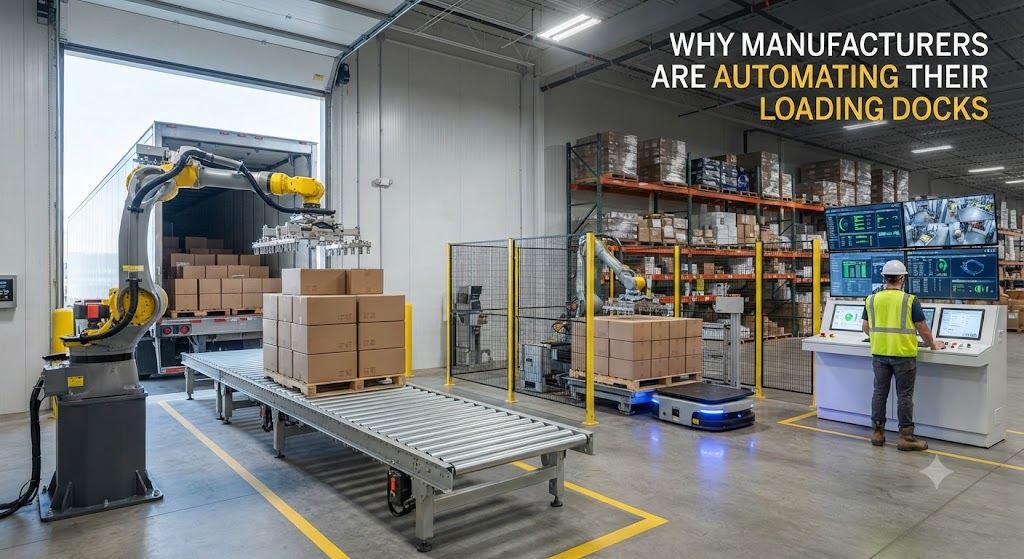
Manual dock work can be strenuous, sometimes leading to injuries and time off. It’s also more difficult to recruit and retain workers in heavy lifting positions, and customers want delivery quicker than ever. Robots are able to operate at a stable rate throughout shifts, stabilize loads during packing and refilling, and minimise damage caused by hurried handling.
Keeping dock times predictable also simplifies scheduling and minimizes expensive truck wait time. That said, benefits aren’t guaranteed and depend on selecting an appropriate solution for your product, space, and workflow.
As you know not every robot is the same as well as their job. Don’t worry we are here to provide you with the main categories:
Before you sign anything, consider these questions:
Expectations will be different. A harmonized, appropriate system has the potential to increase trailer turn rates, decrease repetitive-lift-related injuries and enable a more uniform production rate across shifts. Some results will vary, however, according to product mix, packaging strength and the ability of the robotic system to work with your other equipment. Use what vendors tell you as a benchmark but test it out, and make sure the machine can handle your product by visiting one of their reference customers.
Remember that no machine is perfect. A bit of realism can help avoid frustration. When you assemble different sizes and types of containers and they’re all packed in different ways, you can get misgrips, so it’s worth standardising cartons, pallets and so on.
The initial outlay can seem daunting, but most manufacturers assess payback by the cost in manpower, injuries and damage for several years. Change management is crucial. Staff are nervous about losing work, so involve them early and train them in new jobs, such as working with the robot. And never ignore safety: safety guarding, proximity sensors, simple procedures for workers to follow in front of the robot.
Begin in limited scope. Pilot a single dock door or product line, and adjust as you go before rolling out at scale. Engage your operations, maintenance, IT and safety groups early and often. Request vendor demonstrations with your actual cartons and pallets rather than swag, and develop a set of quantifiable metrics before you begin-whether cycle time, error rate or uptime-and evaluate accordingly.
Robotic loading and unloading can ensure your dock is safer, more efficient and predictable. But it needs to be the right fit for your product, volume and goals. Know your workflow, keep it tested with real loads and start small.
You can’t automate everything simultaneously but you do need a plan. Packaging needs to be thought of as well as this can help ensure robotic handling is easy and predictable. That’s why Yiruixing Technology is a name worth considering when you’re considering how packaging and material handling will work together. Clear that obstacle out of your way and finally make your dock an asset instead of a liability.
Will a robot completely replace my dock workers?
No. Robots handle the bulk of heavy, repetitive lifting, but human operators are still needed to oversee the system, address exceptions, perform goods inspection and manage the dock. Numerous OEMs have actually relocated their staff into higher-value roles rather than decreasing headcount.
Is robotic loading only for big warehouses?
Not now. Large distribution centers led the charge, but now there are solutions for mid-sized manufacturers. The question isn’t “how big is your building?” Instead, it’s “is your volume consistent enough to make the investment worthwhile?”
How do I know if my products are suitable for a robot?
Begin with the fundamentals: carton size, weight and your application. Evenly loaded, solid cartons are the easiest for robots to grip and stack. Uneven loads, damaged cartons or very mixed loads will be more challenging for them, although today’s vision systems are tolerating more variation than they used to.
How much does a robotic loading system cost?
It depends on the system type, your dock configuration, and how much tailoring you require. The price isn’t everything. Installation, integration, training, servicing and replacement parts all have an impact on the real cost, so request a comprehensive quote from suppliers.