

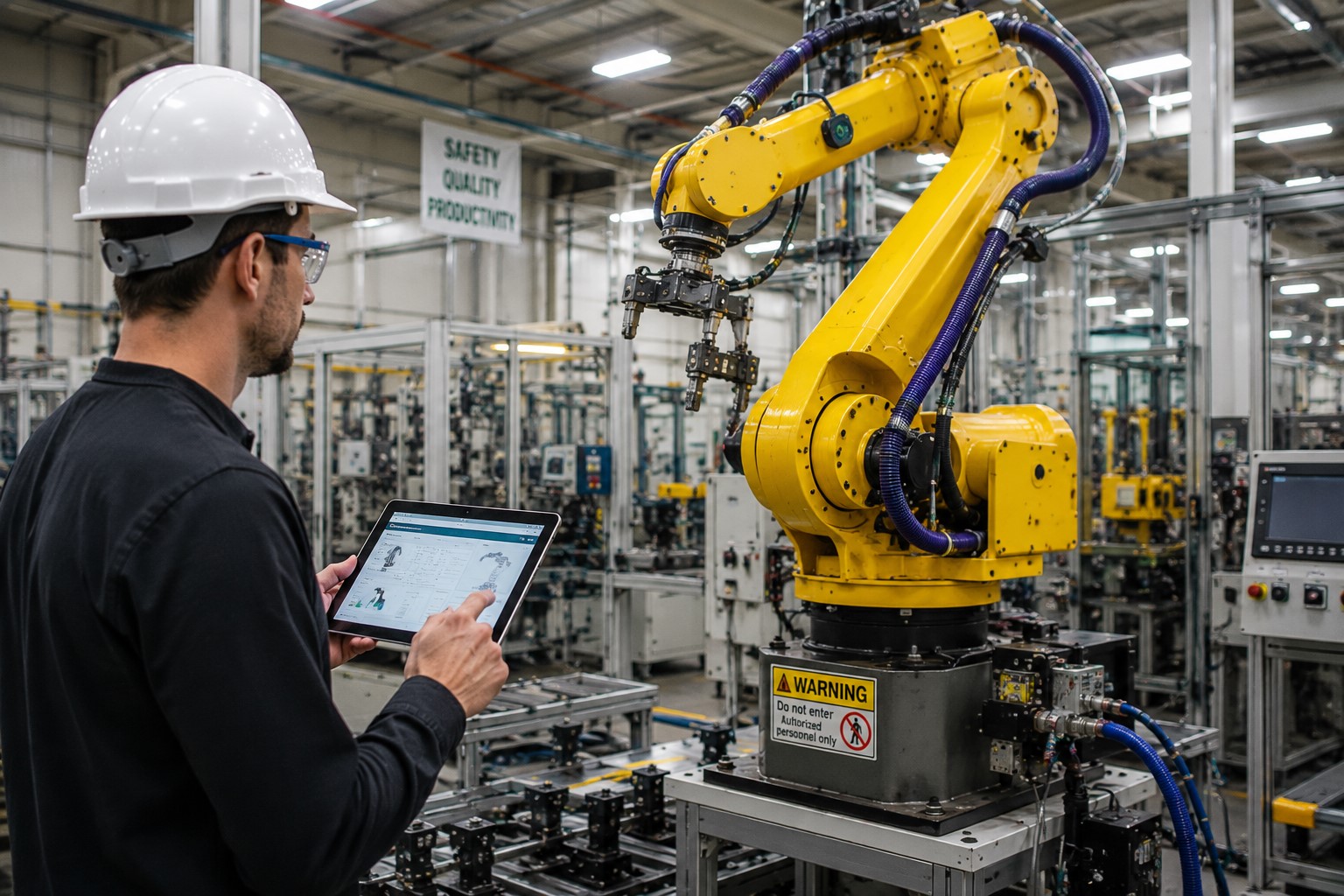
Selecting the appropriate industrial robot for an application is very important and can affect factors such as the speed of the manufacturing process, quality of products manufactured, costs of operation, safety, and scalability. Given that industrial robotic automation is increasingly being adopted by manufacturers around the world, companies are now required to choose robots based on their applications and not necessarily on their capabilities.
According to the International Federation of Robotics (IFR), in 2024, the number of robots installed globally was 542,076, which represents the second-highest number of installations per annum recorded in the history of robotics. The global stock of operational robots increased to 4.66 million, representing an increase of about 9% compared to the previous year.
First and foremost, the industrial robot should be chosen with respect to what it will be used for. Some common applications of industrial robots are welding, machine tending, assembly, material handling, palletizing, packaging, pick-and-place operations, painting, and inspection.
The manufacturers need to look at the current production process and locate tasks that are repetitive, dangerous, physically exhausting, or that require great precision. According to the National Institute of Standards and Technology (NIST), robotics and manufacturing automation help enhance productivity, production capacity, uniformity, quality, yield, and increase safety for employees.
In order to deal with problems related to robotics and manufacturing, the best option is to start with a manufacturing problem first, and after that find the most appropriate robot that will be able to solve the problem.
A robot’s payload is defined as its ability to safely lift a workpiece, tooling, cables, and any other equipment mounted on its arm. Choosing robots by their ability to handle the weight of the product only may lead to low-quality and unreliable results.
For example, if a certain application requires moving a 15 kg piece, engineers need to choose the appropriate payload and tooling, and not the exact 15 kg robot.
The reach of the robot is no less significant. The robot needs to have adequate reach to all necessary positions within the working space and still be able to work with appropriate speed, precision, and stability. The location of layouts, machines, conveyors, fixturing, and access for operators should be taken into account before selecting the robot.
Various types of robots are used for various manufacturing tasks. Articulated robots with six axes of articulation are common for welding, assembly, machine tending, and material handling due to their flexibility and large range of motion.
For high-speed assembly and pick-and-place operations, SCARA robots may be more appropriate, whereas delta robots are usually selected where rapid handling is needed. Cartesian robots may be useful when simple linear movements are required.
Thus, manufacturers need to select robots based on speed, flexibility, accuracy, working space, payload, and application requirements, but not simply by brand or cost.
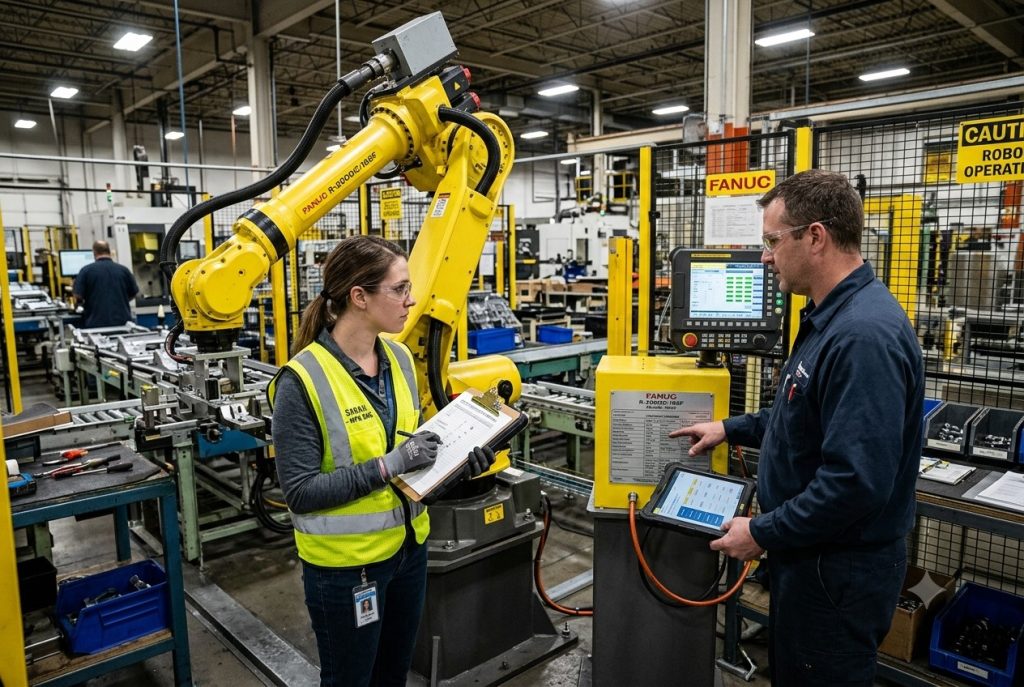
The needs for production should dictate the performance requirements of the robot. Repeatability becomes very important when a task has to be performed many thousands of times repeatedly.
In tasks such as welding, assembly, machining, and precision material handling, the manufacturer should assess the repeatability of the robot and whether it satisfies the tolerance requirements of the task. At the same time, calculate the necessary cycle time.
If the production line needs one complete operation in 20 seconds, then the robotic system, which includes the process of gripping, moving, processing, and releasing, should be able to do so in reality.
Industrial robots are not the only components of an automation system in manufacturing. End-of-Arm Tooling (EOAT), grippers, sensors, vision systems, conveyors, fixturing, PLCs, CNC machines, and safety devices can make a big impact on the performance of the robotic cell.
For instance, in a machine tending job, a robotic system may consist of the robot, a pneumatic or electrical gripper, an interface with a CNC machine, part-positioning fixtures, sensors, and automatic door control. Likewise, a robotic welding cell may include a welding system, positioners, fixtures, a shielding system, and safety devices.
According to NIST, modern industrial robotics involves a combination of technologies like sensors, software, and vision systems, hence making automation more affordable to various manufacturers.
Safety should never be taken lightly when choosing an industrial robot to use in manufacturing. All the dangers associated with robot motion, tooling, workpiece, machinery, electrical systems, and interaction with people have to be considered in the whole robotic cell.
The present ISO 10218-1:2025 standard sets out the safety guidelines for industrial robots, while the ISO 10218-2:2025 standard is responsible for setting out the safety criteria for industrial robot applications and robot cells.
A good risk assessment will, therefore, be necessary beforehand, with sufficient safety measures put in place in the form of safeguards, emergency stops, protective devices, and procedures.
Purchasing cost is not all that manufacturers need to consider. They should take into account the total cost of ownership (TCO), which includes installation, programming, integration, tooling, maintenance, energy consumption, spare parts, training, downtime, and technical support.
The cheaper option of purchasing the robot might not offer you good returns because of higher maintenance and lack of quality service support. On the other hand, high investment costs might be justified due to its superior uptime, productivity, flexibility, and scalability.
Production needs of the company might change at some point. The volume of products could increase, new products could be manufactured, or there could be the need to automate more processes in the company. In such a case, it would be wise to choose a robotic automation solution that is scalable.
According to the IFR, by 2024, the number of robots per 10,000 manufacturing workers was 177 worldwide, whereas the same figure for 2023 was 163.
Selection of the industrial robot for manufacturing purposes is based on various factors including its performance, payload, reach, precision, safety, integration, cost, and scalability. Instead of selecting robots according to specifications or purchase price, it would be better to consider the production process and determine the return on investment.
Yiruixing Technology offers industrial robots, CNC technology, and bespoke automation equipment for manufacturing purposes. The products offered by Yiruixing Technology include robotic arms, welding robots, CNC machines, packing solutions, vision positioning technology, conveyor systems, and material handling systems. Yiruixing Technology creates bespoke automation solutions based on production needs, available floor space, and manufacturing processes. For companies planning to implement automation and intelligent manufacturing, Yiruixing Technology can be viewed as a potential automation and technology partner.
What considerations must I keep in mind when selecting an industrial robot?
The considerations include the application, payload, reach, cycle time, precision, robot configuration, work space, end-of-arm tooling, safety considerations, integration, maintenance, and total cost of ownership.
What is the most suitable industrial robot for manufacturing processes?
There is no one-size-fits-all robot for all cases. Articulated six-axis robots are versatile, but SCARA, delta, and Cartesian robots may be better suited for specific fast, assembly, or linear-movement applications.
Why is payload crucial in industrial robots?
Payload is a very critical factor since it needs to cater for the weight of the part and all tooling that the robot holds. It is important not to choose a robot with insufficient payload capacity.
Should safety standards for robots be considered?
Yes, safety needs to be built into the design of the whole robotic cell. Standards that need to be considered by manufacturers and integrators include ISO 10218-1:2025 for industrial robots and ISO 10218-2:2025 for industrial robot applications and cells.
Can industrial robot automation work for small companies?
Yes. Industrial robot technology can be used in high-volume production and also flexible manufacturing applications. As pointed out by NIST, advancements in sensing, software, and vision systems have made robotics suitable for small manufacturers.