

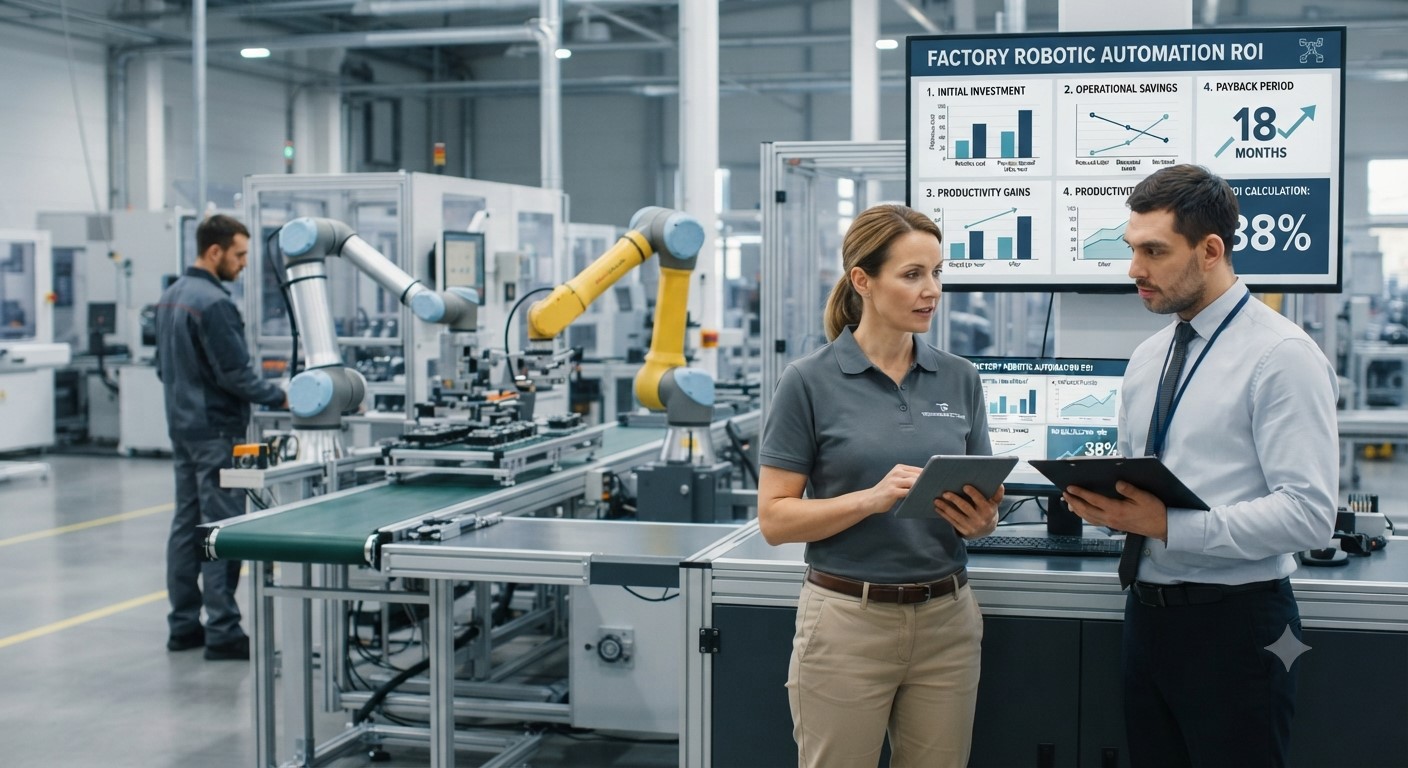
The return on investment for factory robotics automation is how much money an organization makes from its investments in robots, robotic systems, and automation compared to the cost of these investments. The source of ROI could be higher productivity, lower labor costs, product quality improvement, less wastage, higher production capacity, and enhanced safety in the workplace.
If you are a manufacturing organization planning to implement factory automation, then understanding ROI will be important before you invest in robotic arms, cobots, robotic machine tending, inspection, or material handling.
A basic formula for calculating ROI is:
ROI = (Financial Benefits – Total Cost of Automation Investments) ÷ Total Cost of Automation Investments × 100
The total cost of investment is more than just the cost of the robot. The investment cost should factor in the cost of the robotic equipment, EOAT, sensors, vision systems, programming, integration, training, maintenance, safety systems, and operational costs.
Financial benefits could be in lower labor costs, higher production outputs, lower scrap, lower quality costs, lower downtime, and revenue from capacity increase.
NIST advises developing a business case based on the particular manufacturing process and measuring results. An application-specific business case is necessary since the ROI of using robotic automation in the manufacturing industry greatly varies depending on the process itself, volume of production, labor force, and technology used.
A number of factors impact robots’ ROI. They are:
Robots may perform routine operations and allow the workforce to concentrate on more valuable activities. This way, manufacturers may deal with the lack of workers while reassigning them to those activities that require problem-solving skills and knowledge.
Robot automation may result in increased productivity and throughput. According to NIST, efficiency improvement and increased throughput are among the main benefits of manufacturing automation.
Automation may lead to increased repeatability and consistency, thus decreasing the number of defects, rework, and material waste.
Automated machine tending will be able to allow the machines to run for longer without human involvement and therefore help in making the most of the available equipment.
The robots could be used to undertake the hazardous, strenuous, or repetitive tasks and therefore make the workplaces safer.
An automated robotic workcell might add extra production capabilities without necessarily needing an equivalent number of employees. This becomes important as the production levels rise.
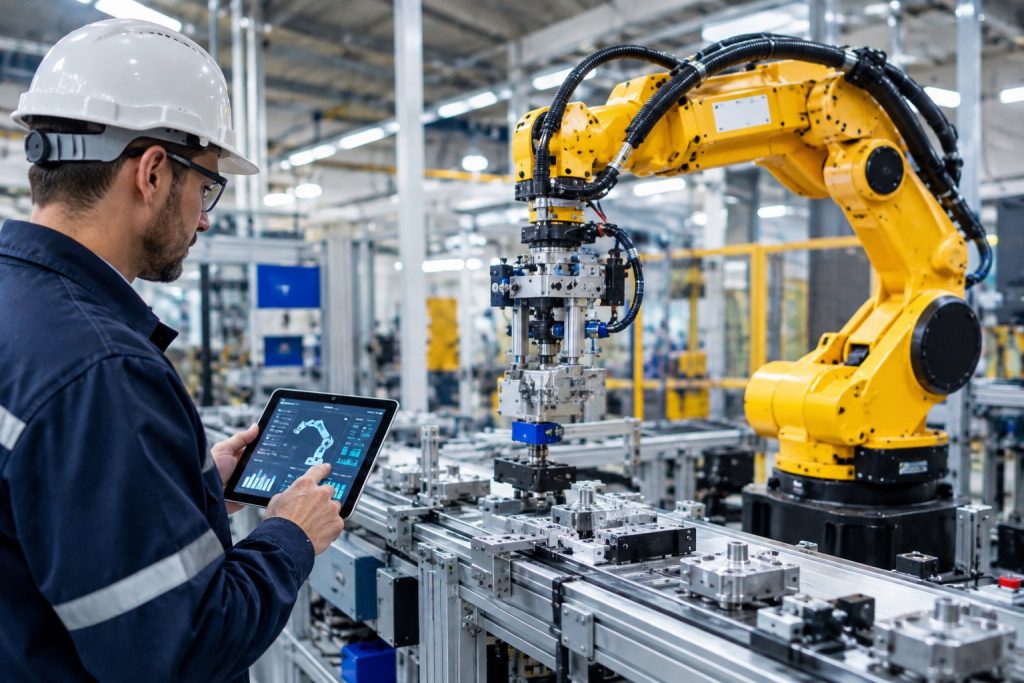
There is no average payback time for factory robotic automation, as it depends on the application, size of investment, number of working hours, labor costs, productivity improvements, and other tangible benefits.
The 2024 NIST Manufacturing Extension Partnership case concerning AMG Industries serves as a practical example. At first, AMG Industries anticipated a payback of about 11.5 months for the collaborative robot application. When productivity and labor improvements had been achieved, the payback was shortened to approximately 6.5 months. There were 38% productivity gains – from 200 to 276 pieces per hour.
As you can see, this is the reason why manufacturers need to calculate ROI based on real process data rather than basing the calculation on some general percentage for an industry.
The best way is to first recognize a particular problem in production and only then choose the right robot to solve the problem. Manufacturers can start with cycle times, labor, downtime, defect rates, throughput, and equipment utilization analysis.
According to NIST, operations should be evaluated, priority automation opportunities identified, the business case formulated within a business strategy, and results measured.
Examples of common applications are robotic machine tending, robotic assembly, inspection, material handling, palletizing, packaging, welding, and collaborative robots.
Also, total cost of ownership should be considered, rather than purchase price alone. Factors such as maintenance, integration, programming, tooling, energy usage, training, and future modifications may have an influence on the financial gain.
Another organization that speaks about the possibilities of smart manufacturing technologies in terms of increased productivity and optimized energy/materials usage is the U.S. Department of Energy.
In the end, the return on investment of factory robotic automation is all about business metrics – not just buying a robot. Through analyzing productivity, utilization, quality, safety, capacity, availability, and total cost of ownership, manufacturers can find out if an automation project meets their financial and business goals.
Ready to convert robotic automation into manufacturing metrics? Yiruixing Technology can help you investigate robotic automation systems built for your production needs. For further information about factory automation and robotic integration, contact Yiruixing Technology. Begin your automation quest now and find out ways to increase productivity and production capacity.
What is the ROI of factory robotic automation?
Return on investment calculates the financial gain a factory receives from robotic automation relative to the investment costs. It may consist of labor savings, increased productivity, reduced waste, and improved quality.
How soon can I recover my investment in robotics?
The payback period depends on the type of application, production scale, labor costs, and complexity of the system. There may be projects that will allow you to recoup your investment in months, while others take longer.
What are the advantages of robot automation?
Some of the advantages of robot automation include improved productivity, consistent quality, reduced repetition in work, improved safety in the workplace, less waste, and increased production capacity.
Are there any benefits for small factories using robotic automation?
Yes. Small manufacturers can choose to automate certain parts of their production process rather than the whole process itself.
What factors impact the ROI of industrial robots?
Labor costs, production output, cycle time, robot utilization, maintenance costs, integration costs, and increased productivity may impact the ROI of industrial robots.